PART 2 — THE LADY WITH TWO EYES
“Mom said if anything bad happened, I had to find the lady with two eyes.”
The room went silent.
Not hospital silent.
Not the kind filled with beeping monitors, rolling carts, and nurses speaking softly behind curtains.
This was deeper.
This was the silence that opens under your feet when the past finds your name and says, I am not finished with you.
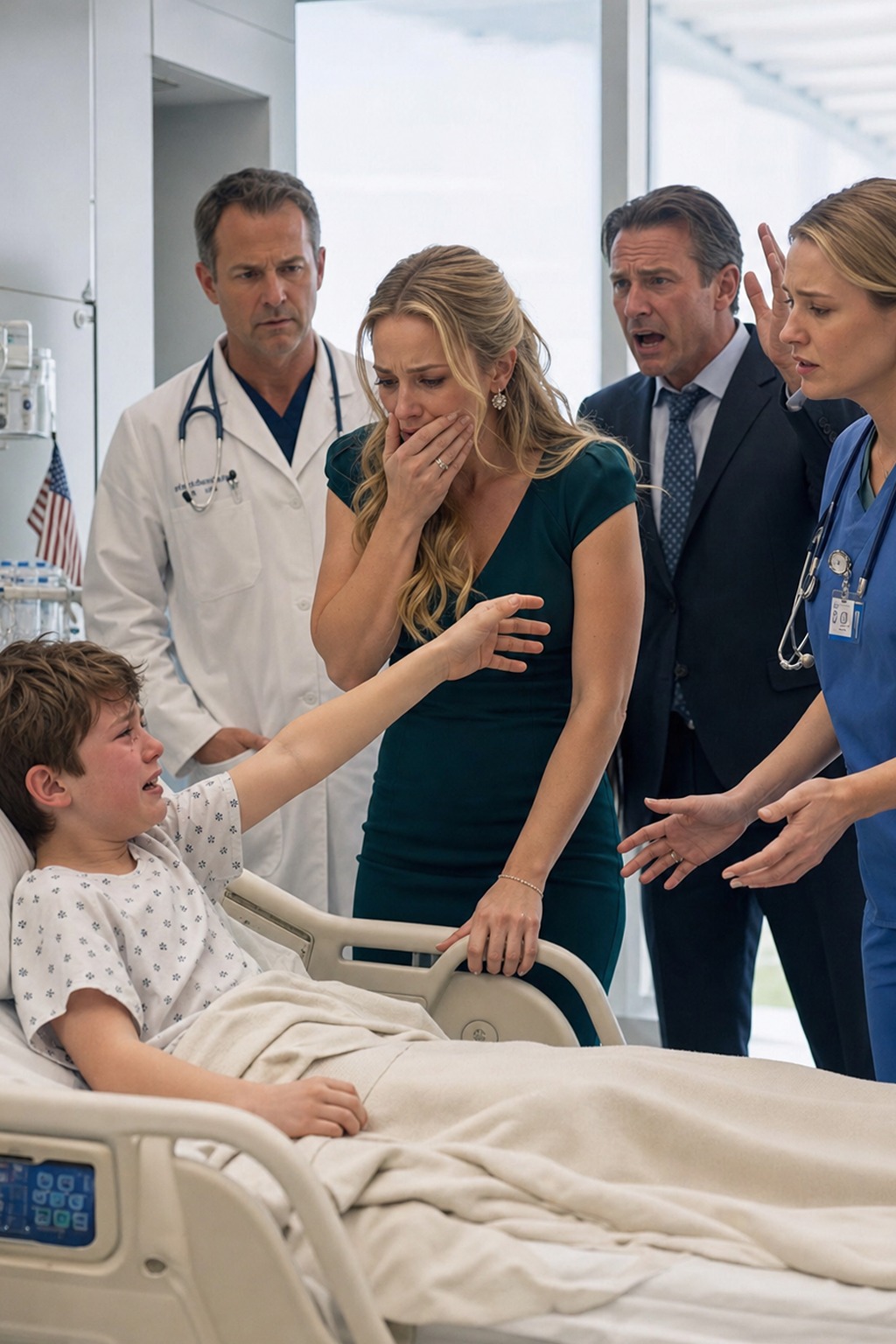
I stood in the doorway of room twelve, one hand still on the cold metal rail of the curtain, staring at the little boy in the bed.
Oliver Vance.
Eleven years old.
Fractured wrist.
Mild concussion.
Bruised cheek.
Split lip.
And my full name, phone number, and address written on a card in his backpack.
“Lady with two eyes?” I repeated, because my mind was moving too slowly to understand anything else.
Oliver swallowed. His gaze flicked to my face, then away, then back again.
“One green,” he whispered. “One brown.”
My fingers went to my left eye before I could stop myself.
I had heterochromia. My right eye was dark brown, my left a strange mossy green. Most people noticed eventually. Some stared. Some pretended not to. In college, Rachel had called me “the girl with two truths in her face.”
Later, when she was angry, she had called me something else.
A witness.
That word had ended our friendship.
My throat tightened.
“What else did your mom say?” I asked.
Oliver looked past me toward the hallway.
Nurse Maribel stepped closer, but he recoiled slightly, the kind of tiny movement children make when they have learned adults can be dangerous.
I raised my hand gently.
“It’s okay,” I told Maribel. “Can I sit?”
She nodded.
I moved slowly to the chair beside his bed, careful not to crowd him.
His backpack sat on the side table, damp from the rain, one strap torn. It was navy blue with a faded astronaut patch on the front. The sight of it nearly broke me for reasons I couldn’t explain. There is something unbearable about a child’s backpack in a hospital room. It belongs in school hallways, on kitchen floors, beside lunch boxes. Not beside an IV stand.
Oliver watched every movement I made.
I sat.
“I’m Nora,” I said softly.
“I know.”
“How?”
“Mom showed me your picture.”
The words struck harder than they should have.
Rachel had kept a picture of me.
After twelve years.
After that night.
After the silence.
“What picture?” I asked.
Oliver hesitated.
“The one with the fountain. You had paint on your jeans. Mom was laughing.”
I knew that photo.
Freshman year.
Rachel and I sitting on the edge of the campus fountain after sneaking out of a terrible orientation mixer. She had stolen a slice of cake from the dessert table. I had spilled blue paint on my jeans from a theater set I was helping build. We were nineteen and invincible in the way only lonely girls can be when they finally find each other.
I had not seen that photo since the night Rachel disappeared from my life.
My voice nearly failed.
“Where is your mom, Oliver?”
His lips trembled.
“I don’t know.”
Maribel touched the foot of the bed.
“Oliver was brought in by EMS after a two-car accident near Burnside Avenue. The driver of the car he was in fled before police arrived.”
My head snapped toward her.
“The driver fled?”
Maribel’s mouth tightened.
“Yes. Witnesses said a dark SUV struck the passenger side, then another adult pulled Oliver from the car and left before paramedics got there.”
“What adult?”
“We don’t know yet.”
Oliver’s breathing quickened.
I turned back to him.
“Oliver. Were you with your mom?”
His right hand curled into the blanket.
“No.”
“Who were you with?”
He stared at the doorway.
“Uncle Grant.”
A coldness entered the room.
“Grant Vance?” Maribel asked.
Oliver nodded once.
I looked at her.
“Who is Grant Vance?”
“My dad’s brother,” Oliver whispered.
“Where is your dad?”
The boy’s face went blank.
Not confused.
Trained.
“I’m not supposed to talk about him.”
That answer told me more than any explanation could have.
I leaned closer, keeping my voice steady.
“Oliver, listen to me. I know you’re scared. I know adults have probably asked you too many questions tonight. But your mother sent you to me for a reason. If she is in danger, I need to understand.”
His eyes filled.
“She told me if Uncle Grant came, I had to run.”
My stomach dropped.
“Did he take you?”
Oliver gave a tiny nod.
“From where?”
“School.”
“When?”
“Today. After lunch. He said Mom was sick and told him to get me. But Mom never sends Uncle Grant.”
“Why not?”
His mouth twisted.
“Because he works for my dad.”
The monitor beside him beeped faster.
Maribel stepped forward.
“Oliver, honey, slow breaths.”
“I tried to call Mom,” he said, words beginning to tumble out now. “But Uncle Grant took my phone. He said Mom was confused again. He said she was making things ugly. Then we got in the car and he kept asking where she hid the file.”
“What file?” I asked.
Oliver shook his head.
“I don’t know. Mom told me never to say file, key, or Nora unless it was an emergency.”
I heard my own name like a match striking in a dark room.
File.
Key.
Nora.
Rachel, what did you drag to my door?
Oliver’s eyes went to his backpack.
“She said the card was only for the worst day.”
The worst day.
I reached toward the backpack slowly.
“Can I look?”
He nodded.
Maribel watched as I unzipped the front pocket.
Inside were ordinary things first.
A bent library card.
Two pencils.
A granola bar.
A pack of tissues.
A small plastic dinosaur with one missing leg.
Then, tucked into the inner seam, I found a sealed envelope.
My name was written across the front.
NORA ELLISON.
Not in a child’s handwriting.
In Rachel’s.
My hands started shaking.
For twelve years, I had imagined what I would say if Rachel ever contacted me again.
I had imagined anger.
Closure.
Accusations.
Maybe an apology.
I had never imagined her handwriting on an envelope pulled from her injured son’s backpack in a hospital room after a hit-and-run.
I opened it.
Inside was a single sheet of paper and a small brass key taped to the bottom.
Nora,
If Oliver is with you, then I failed to outrun them.
Please do not hate me long enough to make the wrong choice.
I know I don’t deserve your help. I know what I let them do to you. I have lived with that every day for twelve years.
But my son is innocent.
His father is not.
If I disappear, do not give Oliver to Elias Vance. Do not trust Grant. Do not trust anyone from Blackridge House.
The file is where we buried the blue scarf.
You were right that night.
I lied because I was afraid.
Rachel
I read the last line again.
You were right that night.
I lied because I was afraid.
The hospital room tilted.
I gripped the paper hard enough to crease it.
For twelve years, that night had lived in me like a locked room.
Rachel and I had been seniors at Halewick University. She was brilliant, messy, theatrical, and full of storms. I was quieter, cautious, the scholarship girl who counted every dollar twice. We became best friends because she made the world bigger and I made sure she survived it.
Then came Elias Vance.
Twenty-six. Graduate donor fellow. Old family money. Beautiful in the way knives are beautiful when polished.
Rachel fell for him.
I distrusted him immediately.
He knew too much about what people wanted. He bought affection with attention, then punished disobedience with silence. When Rachel started changing—missing classes, covering bruises with long sleeves, laughing too loudly when I asked questions—I began writing things down.
Dates.
Photos.
Messages.
A blue scarf torn near the fountain.
Then one night, Rachel came to our dorm trembling, mascara running down her face, saying Elias had hurt her and threatened to destroy her if she spoke.
I took her to campus security.
By morning, everything changed.
Rachel withdrew the statement.
Elias claimed I had invented the accusation because I was jealous.
Rachel confirmed it.
She looked me in the eye in front of the dean and said, “Nora has always been obsessed with me. She made this up.”
I lost my campus job.
My fellowship recommendation vanished.
My reputation collapsed.
Rachel left school two weeks later.
And I never saw her again.
Until now.
Not her face.
Her son.
Her letter.
Her confession.
I folded the paper with mechanical care.
Maribel was watching me.
“Ms. Ellison?”
I looked at Oliver.
The boy was staring at me with terrified hope.
He knew the letter mattered.
He knew I was deciding something.
And beneath that, he was asking a question no child should ever have to ask.
Are you going to leave me too?
I stood.
“No,” I said quietly.
Maribel blinked.
“Sorry?”
I looked at Oliver.
“No one from the Vance family takes him tonight.”
Maribel exhaled.
“I’ve already contacted the social worker.”
“Good. Contact hospital security too.”
Oliver’s eyes widened.
“They’ll come?”
“Yes,” I said. “Probably.”
His face went pale.
I stepped closer to his bed.
“Oliver, I need you to listen to me carefully. I am not your mother. I do not know everything that is happening yet. But your mother trusted me with the worst day. So on the worst day, I am going to do exactly what she asked.”
His chin trembled.
“Does that mean you’ll stay?”
I looked at Rachel’s handwriting in my hand.
I thought of the girl by the fountain.
The lie.
The twelve years.
Then I looked at the boy she had raised to find me when the world broke.
“Yes,” I said. “I’ll stay.”
For the first time since I entered the room, Oliver cried.
Not loudly.
Not like a child throwing himself into grief.
He simply turned his face toward the pillow and broke quietly, as if even his tears had been trained not to inconvenience anyone.
I sat beside him until he fell asleep.
At 1:17 a.m., the Vance family arrived.
They did not come like worried relatives.
They came like ownership.
Three people swept into the pediatric wing with expensive coats, polished shoes, and the entitlement of people who had never heard the word no without assuming it was a clerical error.
The first was Grant Vance.
Tall, narrow-faced, with rain on his shoulders and a bandage across his temple. He looked less like a grieving uncle than a man annoyed by traffic.
Behind him came an older woman with silver hair and a black cashmere coat.
Margot Vance.
I knew her face from old society pages. Elias’s mother. Board member. Philanthropist. Professional mourner for causes that photographed well.
The third was Elias.
For twelve years, memory had kept him young.
Reality had improved him in all the wrong ways.
He was thirty-eight now, broader, sharper, wearing a navy overcoat and an expression of controlled distress. His hair was darker than I remembered, his face cleaner, his eyes the same.
Cold.
Assessing.
Predatory.
He saw me before anyone spoke.
Recognition passed through his face.
Then amusement.
“Nora Ellison,” he said softly. “Of course.”
My skin crawled.
I stood between them and Oliver’s room.
Maribel had warned security. Two guards stood near the nurses’ station, pretending not to listen.
Elias smiled at them, then at me.
“We’re here for my son.”
“Oliver is sleeping,” I said.
Margot Vance’s gaze moved over me like I was something left on a table by mistake.
“And who are you to prevent a father from seeing his child?”
“The emergency contact his mother listed.”
Grant laughed once.
“That was Rachel being dramatic.”
I looked at the bandage on his forehead.
“Were you driving when the accident happened?”
His smile vanished.
Elias stepped in smoothly.
“My brother was trying to bring Oliver to safety during one of Rachel’s episodes.”
“Her episodes?”
He sighed, as if already weary of being generous.
“Rachel has struggled for years. Mental instability. Paranoia. False accusations. Unfortunately, Nora, you know something about that.”
There it was.
The old knife.
Still sharp.
Still familiar.
Twelve years ago, that sentence would have frozen me.
Tonight, it clarified the room.
“You mean the accusation Rachel made against you in college?” I asked.
Elias’s smile thinned.
“The accusation you fabricated.”
I lifted Rachel’s letter slightly.
“Interesting. She says otherwise.”
His eyes flicked to the paper.
Tiny movement.
But I saw it.
So did Maribel.
So did the nearest security guard.
Margot’s voice hardened.
“Where did you get that?”
“Oliver’s backpack.”
Grant stepped forward.
“That belongs to the family.”
I did not move.
“No. It belongs to the police now.”
Elias’s expression did not change, but something behind his eyes turned violent.
“Ms. Ellison,” he said, dropping the softness, “you are a stranger to my son. You have no legal standing, no custody, and no idea what damage Rachel has done.”
“Then let’s call the police and sort it out.”
Grant muttered something under his breath.
Margot lifted her chin.
“We have already contacted our attorney.”
“I hope you contacted a good one.”
Elias smiled again.
“You always did have a talent for making bad decisions with confidence.”
Before I could answer, a small voice came from behind me.
“Nora?”
Oliver stood in the doorway.
Barefoot.
Hospital gown hanging off one shoulder.
His casted wrist pressed against his chest.
His eyes locked on Elias.
He looked terrified.
Elias’s face transformed instantly.
Warmth.
Concern.
Fatherhood, perfectly lit.
“Oliver,” he said, opening his arms. “Come here, buddy.”
Oliver stepped backward.
The hallway went silent.
Elias’s arms remained open for one humiliating second too long.
Then he lowered them.
“Oliver,” he said gently, “your mother is confused again. We need to find her. Come with me.”
Oliver shook his head.
Margot’s face tightened.
“Sweetheart,” she said, “this woman is not family.”
Oliver looked at me.
Then at Elias.
Then he said, “Mom said if Dad came, I should ask him where the blue scarf is.”
Elias stopped breathing.
I felt it.
A small, electric silence.
Grant looked at Elias too quickly.
Margot’s lips parted.
Oliver did not understand what he had done.
But Rachel had.
Rachel had planted a tripwire in her child’s memory.
The blue scarf.
The one from that night.
The one Rachel said I had invented.
Elias recovered fast.
“I don’t know what that means.”
“Yes, you do,” I said.
He turned toward me.
For the first time, the charm was gone.
Underneath was the same man I had seen for one second in a campus hallway twelve years ago, when Rachel passed him with her head down and he whispered something that made her flinch.
“I would be careful,” he said quietly. “You ruined your life once trying to involve yourself in things you didn’t understand.”
“No,” I said. “I lost twelve years because Rachel was afraid. But fear has a shelf life. Evidence doesn’t.”
At that moment, two police officers stepped out of the elevator.
Maribel had called them.
Elias turned toward them with relief so polished it almost worked.
“Officers,” he said, “thank God. My son has been kept from me by this woman.”
The older officer looked at me.
Then at Oliver.
Then at Grant’s bandaged head.
Then at Elias.
“Everyone stay where you are.”
For the next two hours, the hospital became a battlefield made of paperwork.
Elias produced documents showing he was Oliver’s legal father.
I produced Rachel’s letter.
Oliver told the officers Grant took him from school without his mother’s permission.
Grant claimed Rachel had asked him to.
The school confirmed no such authorization had been given.
Hospital security produced footage of Oliver recoiling when Elias approached.
The police requested traffic camera footage from Burnside.
A social worker named Denise arrived at 2:40 a.m., wearing a wrinkled blazer and the expression of a woman who had seen rich people weaponize family court before breakfast.
She interviewed Oliver privately.
When she came out, her face was calm.
Too calm.
I had spent enough time around professionals to know when calm meant fury.
“Pending further investigation,” Denise said, “Oliver will remain in protective custody. Mr. Vance, you are not permitted unsupervised access tonight.”
Elias stared at her.
“You cannot be serious.”
“I am.”
“I am his father.”
“And there are credible concerns regarding immediate safety.”
Margot stepped forward.
“This is outrageous. Do you know who my family is?”
Denise looked at her.
“Yes.”
One word.
Perfect.
Margot recoiled as if slapped.
Elias looked at me one last time.
“You have no idea what Rachel has done.”
I held his gaze.
“Then find her.”
He said nothing.
That was how I knew he already had.
By dawn, I was sitting in a plastic hospital chair beside Oliver’s bed while a social worker slept badly in a chair near the door.
Oliver woke just after sunrise.
For a moment, panic flashed across his face.
Then he saw me.
“You stayed,” he whispered.
“I said I would.”
He blinked.
“Adults say stuff.”
“Yes,” I said. “They do.”
He studied me with solemn suspicion.
“Are you mad at my mom?”
The question moved carefully between us.
I could have lied.
Children know when adults lie. They may not have the words for it, but their bodies know.
“Yes,” I said.
His face fell.
“I’m sorry.”
“No. You don’t carry that. Your mother and I had something happen a long time ago. I was hurt. She was scared. Those things can both be true.”
He looked down at his cast.
“She cries when she looks at your picture.”
My chest tightened.
“What does she say?”
“That you were the bravest person she ever betrayed.”
I turned away for a moment.
The hospital window had gone pale with morning. Cars moved through wet streets below. Somewhere a baby cried. Life continued with its usual cruelty.
When I could speak again, I asked, “Oliver, do you know where your mom might be?”
He hesitated.
“She said if she disappeared, she was either running or buried.”
I closed my eyes.
“Buried where?”
“I don’t know. She didn’t mean dirt, I think. She meant hidden.”
Smart boy.
Terrified boy.
Rachel’s boy.
“What is Blackridge House?” I asked.
His face changed.
He glanced toward the door.
“It’s Dad’s family house.”
“Do you go there?”
“Sometimes.”
“What happens there?”
He picked at the blanket.
“Meetings. Grandma says it’s where important people fix problems.”
“What kind of problems?”
“People problems.”
I felt cold spread through me.
“Did your mom go there recently?”
He nodded.
“She went last week. She came back crying. Then she packed bags but didn’t leave. She said we had to wait for the file first.”
“The file where we buried the blue scarf,” I murmured.
Oliver looked up.
“You know where that is?”
I did.
God help me.
I knew exactly where that was.
Halewick University had a tradition senior year. Students buried small time capsules beneath a row of sycamore trees near the old amphitheater. Not officially. Not legally. Just drunk, sentimental young people leaving nonsense for their future selves.
Rachel and I had buried a tin box.
Inside were photos, cheap jewelry, a mixtape, a fake wedding veil from a costume party, and a blue scarf.
Not the real scarf.
I thought it had been a joke.
That night, after campus security dismissed Rachel’s first statement and before she turned on me completely, she shoved the scarf into my hands and said, “Hide it where we hide everything that matters.”
I thought she meant keep it safe until she was ready.
I buried it in the tin box.
The next morning, she lied.
For twelve years, that scarf had been under a sycamore tree.
Unless Rachel had dug it up.
I stood.
Oliver watched me.
“I need to go somewhere.”
His face tightened.
“But you’ll come back?”
The question cut me open.
“Yes,” I said. “But this time, I’m going to tell three adults where I’m going, leave a written record, and make sure nobody can pretend I vanished.”
His brows pulled together.
“That sounds intense.”
“It is called being a woman with experience.”
He almost smiled.
Progress.
I called Detective Ana Ortiz.
Not because I knew her from another case.
Because every retired prosecutor has at least one detective whose number they never delete.
Ana answered on the third ring.
“Someone better be dead or lying.”
“Possibly both,” I said.
She sighed.
“Nora?”
“I need help.”
By noon, Ana and I were driving toward Halewick University in her old black Jeep.
Ana was sixty-two, built like a locked filing cabinet, and had once testified that I was “the most stubborn civilian she had ever been forced to cooperate with.” She meant it as praise.
I told her everything on the drive.
Rachel.
Elias.
The accusation.
Oliver.
The accident.
The letter.
The blue scarf.
When I finished, Ana was quiet for nearly a mile.
Then she said, “You kept the location to yourself for twelve years?”
“I thought it was meaningless after she lied.”
“Evidence is never meaningless. Only waiting.”
I looked out the window.
Rain clouds gathered again.
“Do you think Rachel is alive?”
Ana’s hands tightened on the wheel.
“I think rich men don’t panic over dead women unless dead women left receipts.”
Halewick had changed.
The old theater building was now a media innovation center. The student union had glass walls. The fountain where Rachel and I once laughed had been replaced by something modern and ugly that looked like expensive plumbing.
But the sycamore trees remained.
We found the third one from the amphitheater steps.
My knees ached as I crouched.
Ana handed me a small garden trowel.
“You always bring that?”
“You always ask questions before digging up felony-adjacent artifacts?”
I started digging.
The soil was damp and heavy.
Six inches.
Ten.
Fourteen.
Then the trowel struck metal.
My breath stopped.
Ana knelt beside me.
Together, we pulled out a rusted tin box.
The painted flowers on the lid were almost gone.
For a second, I saw Rachel at twenty-one, laughing in the dark, whispering, “Future us will be so embarrassed.”
Future us had never arrived.
I opened the tin.
Inside, time had rotted most things.
Photos blurred.
Paper softened.
The fake veil had yellowed.
But the blue scarf remained sealed inside a plastic bag.
And beneath it was something that had not been there twelve years ago.
A flash drive.
A folded note.
Rachel’s handwriting again.
Nora,
If you found this, I am either dead, missing, or finally brave.
I came back here because this is the only place I ever told the truth before I took it back.
The scarf has Elias’s blood on it and mine.
The drive has copies of what I found at Blackridge House: payments, sealed settlements, photographs, names, and the video from the night he hurt me.
I let them call you a liar because Elias said he would send my father to prison, ruin my sister’s medical care, and make sure your scholarship vanished anyway.
Then I married him because I thought survival meant choosing the cage with better furniture.
I was wrong.
I am sorry, Nora.
I should have said that before I needed you.
Protect Oliver.
Rachel
Ana read over my shoulder.
“Damn,” she said softly.
The scarf lay between us like a sleeping witness.
My hands trembled, but this time not from fear.
From recognition.
I had not been crazy.
I had not invented the bruises.
I had not misread Elias.
I had not lost everything because I was reckless.
I lost it because Rachel was trapped, Elias was powerful, and everybody around us preferred a neat lie to an ugly truth.
Ana put the scarf and drive into separate evidence bags.
“Chain of custody starts now.”
I almost laughed.
“Can you do that retired?”
“I can do it until someone tells me not to, and then I’ll do it louder.”
We took the evidence directly to Detective Lyle Mercer, the officer assigned to Oliver’s case.
By evening, the flash drive was in forensic review.
By midnight, police found the first video.
I was not allowed to see it.
I did not need to.
Detective Mercer called me at 12:46 a.m.
His voice was flat.
Professional.
Furious.
“The drive contains evidence connected to multiple possible crimes involving Elias Vance and associates over at least fifteen years.”
“Rachel?”
“We found recent recordings. She was gathering evidence. She documented meetings at Blackridge House.”
“Is she alive?”
A pause.
“We don’t know.”
“Detective.”
“We found one audio file dated three days ago,” he said. “In it, she says she believes Elias knows about the drive. She says if anything happens to her, Oliver should go to you.”
My hand tightened around the phone.
“Anything else?”
“Yes.”
His voice lowered.
“She says she is going to confront Margot Vance.”
The next morning, they found Rachel’s car.
Abandoned near the river.
Driver’s door open.
Blood on the steering wheel.
No body.
Elias Vance held a press conference before police held their second briefing.
He stood outside Blackridge House beneath white columns with his mother beside him and cameras arranged like guests at a wedding.
“My wife Rachel,” he said, voice breaking beautifully, “has struggled for many years with paranoia and emotional instability. Our only concern is finding her and protecting our son from further trauma.”
He paused.
Looked down.
Perfect sorrow.
“Unfortunately, certain people from Rachel’s past have reappeared and may be exploiting her condition for attention.”
Certain people.
Me.
I stood in my living room watching him on television, Oliver asleep upstairs under temporary protective placement approved by Denise because he refused to go anywhere else and because, apparently, writing a woman’s name on an emergency card carries more weight when every man around the child looks like a flight risk.
Ana stood beside me, arms crossed.
“He’s good,” she said.
“He was always good.”
On screen, a reporter asked, “Mr. Vance, did your brother remove Oliver from school without authorization?”
Elias’s jaw tightened.
“My brother acted in good faith during a family emergency.”
Another reporter: “Is it true police have recovered evidence from Halewick University connected to an old accusation against you?”
Margot stepped forward.
“This family will not dignify decades-old lies.”
Elias touched her arm gently.
“Mother.”
The cameras loved it.
The protective son.
The grieving husband.
The endangered father.
I turned off the television.
Oliver’s voice came from the stairs.
“He’s lying.”
I turned.
He stood in borrowed pajamas, one hand on the railing.
“Yes,” I said.
“He always sounds nicest when he’s lying.”
Ana’s face softened.
Oliver descended slowly.
“Will people believe him?”
I thought about my own ruined reputation.
Rachel’s silence.
The dean who never called me back.
The friends who stopped sitting beside me.
“Yes,” I said. “Some will.”
His face fell.
“But not the people who matter most right now.”
“Who matters?”
“The police. The court. Your mother. You. Me.”
He considered that.
Then he asked, “Can breakfast matter?”
For the first time in twenty-four hours, I smiled.
“Breakfast can absolutely matter.”
I burned the pancakes.
Oliver ate three.
Children are merciful when hungry.
The case moved faster than Elias expected because he had miscalculated one thing.
Rachel had spent twelve years learning from the man who trapped her.
She knew he would charm police.
She knew he would attack her credibility.
She knew he would call her unstable.
So she documented everything.
Not emotionally.
Precisely.
The flash drive contained bank transfers, encrypted messages, settlement agreements involving women who had worked for Vance companies, photographs of injuries, recordings of threats, names of doctors paid to sign evaluations, and one video from twelve years ago.
The night at Halewick.
Rachel’s original statement.
The one that disappeared.
A campus security officer had secretly copied it before it was erased. Rachel found it years later in a private investigator’s file and saved it.
In the video, twenty-one-year-old Rachel sat in a gray interview room with a bruise blooming beneath her cheekbone and my jacket around her shoulders.
Beside her sat me.
Young.
Terrified.
Furious.
Rachel told the truth.
Elias hurt me.
Nora found me.
Nora saved me.
By morning, that truth had been buried.
Now it had climbed out of the ground wearing a blue scarf.
Elias was arrested three days after the press conference.
Not for Rachel yet.
For kidnapping-related conspiracy, obstruction, evidence tampering, financial coercion, and witness intimidation. Grant was arrested too. Margot’s house was searched under warrant.
Blackridge House made the evening news.
Police carried out boxes under a gray sky while helicopters circled above.
Oliver watched from my couch with a blanket around his shoulders.
When Elias appeared on screen being escorted into a police car, Oliver did not smile.
He asked, “Does this mean Mom can come home?”
I had no answer.
So I gave him the only honest thing I had.
“It means we are closer.”
The call came six hours later.
Rachel was alive.
Barely.
She had been found in a private “wellness facility” two counties over under a false name, heavily sedated, admitted under paperwork signed by a physician tied to the Vance family foundation.
When Detective Mercer told me, I sat down on the kitchen floor.
Not a chair.
The floor.
Ana found me there.
“Nora?”
“She’s alive,” I whispered.
Oliver heard.
He ran so fast he slipped in his socks.
“Mom?”
I opened my arms.
He crashed into me.
“She’s alive?” he sobbed.
“Yes.”
“Can I see her?”
“Soon.”
“When?”
“When doctors say it’s safe.”
He cried harder.
This time, not quietly.
This time, he made noise.
I held him and thought of Rachel somewhere in a hospital bed, having clawed through twelve years of fear to get her child to the one woman she had hurt badly enough to believe would never forgive her.
She had been wrong.
Not because forgiveness was easy.
Because Oliver was innocent.
Because truth mattered.
Because some doors, once opened, cannot be shut again.
I saw Rachel two days later.
The hospital had placed her under police protection.
She looked nothing like the girl from the fountain.
Of course she didn’t.
None of us did.
Her face was thinner. Her hair had been cut badly, as if someone had done it without asking. There were needle bruises on her arms. Her lips were cracked. But her eyes were Rachel’s.
Tired.
Haunted.
Alive.
When I entered the room, she turned her head.
For a moment, we were twenty-one again.
Then her face crumpled.
“Nora.”
I stopped at the foot of the bed.
There were twelve years between us.
read more in next page